Bow Legs

Bow legs are a condition that can result from congenital problems, disease or injury.

Genu Varum (bowed legs)

Angular deformities of the knee are common during childhood and usually are variations in the normal growth pattern. Angular deformity of the knee is a part of normal growth and development during early childhood. Physiologic angular deformities vary with age as:

  • During first year: Lateral bowing of tibia
  • During second year: Bow legs (knees and tibia)
  • Between 3-4 years: Knock Knees

The condition usually becomes more evident when the child is 2 to 3 years old and normally corrects itself by the time a child is 7 or 8 years old. However, if the condition is not corrected it could be a sign of an underlying disease that requires treatment.
orthopedic-trauma

A perfectly aligned knee has its load-bearing axis on a line that runs through the hip, knee and ankle. Based on the inward/ outward inclination of the head of tibia/fibula; knee angular deformities are classified as:

  • Genu valgum (knock-kneed): Head of tibia/fibula (not the joint itself), is inclined away from the midline of the body
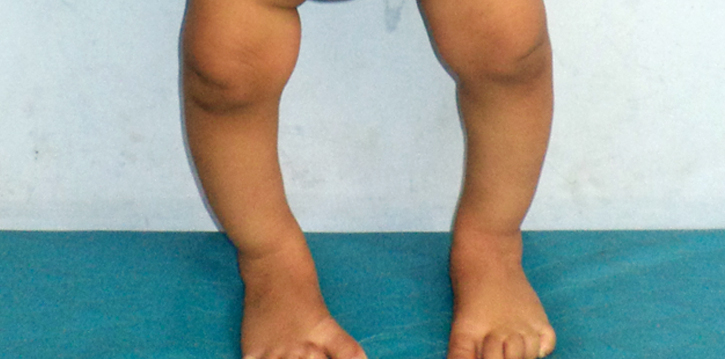
  • Genu varum (bow-legged): Head of tibia/ fibula is inclined toward the midline of the body

Genu Varum (bowed legs)

Bowed legs are very common in toddlers. If a child has bowlegs, one or both legs curve outwards. When your child stands there is a distinct space between the lower legs and knees. Bowed legs are rarely seen in adolescents. In most of the cases, children with bowed legs are significantly overweight.

The common causes of bowed legs include:

  • Physiologic Genu Varum: Most childrenbelow the age of 2, showbowing of the legs as a part of normal physiological process. Normally the bowing will correct by 3 to 4 years of age and the legs may have a normal appearance.
  • Blount’s disease: It is a condition in which there is an abnormality of the growth plate at the upper portion of the tibia (shinbone).
  • Rickets: It is bone disease that occurs in children due to deficiency of calcium, phosphorus, or vitamin D that are essential for healthy bone growth.
  • Trauma
  • Infection
  • Tumor
Frequently Asked Questions

Bowlegs that do not straighten as your child begins to walk may be caused by more serious problems such as:

  • Rickets, a bone growth problem caused by lack of vitamin D or calcium
  • Blount’s disease, a bone growth disorder in the shinbone (tibia)
  • Abnormal bone development
  • Fractures that do not heal correctly
  • Lead or fluoride poisoning

Bowlegs are usually easy to see, but most cases self-correct by age 3. If your child still shows any of the following symptoms after age 3, please see your pediatrician:

  • Bowed legs that continue or worsen after age 3
  • Knees that do not touch when the child is standing with feet and ankles touching
  • Similar bowing in both legs (symmetrical)
  • Reduced range of motion in hips
  • Knee or hip pain that is not caused by an injury

Your pediatrician can usually diagnose bowlegs just by examining your child. Other tests your physician may recommend to diagnose bowlegs or an underlying condition include:

  • Measurement of the distance between the knees while your child is lying on his or her back
  • Observation of how your child walks to determine any abnormalities
  • Blood tests to check for a vitamin D or calcium deficiency
  • X-rays to check for any problems with leg bone growth

Children with bowlegs usually don’t need treatment unless the condition is extreme or your child has a more serious underlying condition. In those cases, we recommend these options:

  • Checkups at least every six months so the pediatrician can monitor your child’s leg growth and development
  • Vitamin D and calcium supplements to treat and cure rickets
  • Braces or other orthopaedic devices for children under age 3 who have Blount disease or other serious conditions
  • Surgery for children over age 3 who have Blount disease or other serious conditions